Experience stories in painted frames.
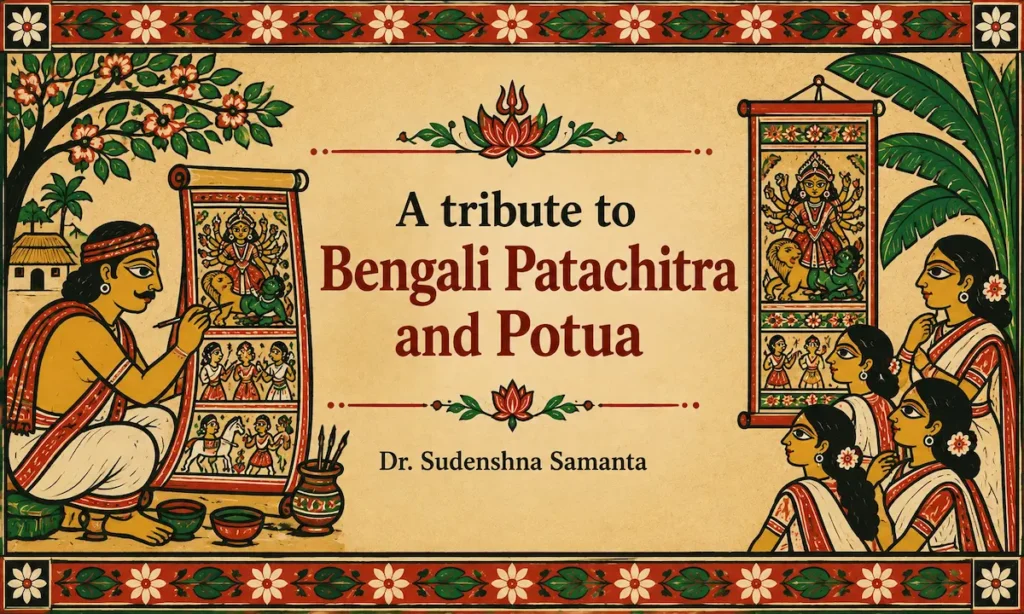
The Bengal Patachitra tradition is believed to have originated around the 13th century, though references to it appear in literature as early as the 1st to 7th centuries A.D. This art form uniquely blends painting with storytelling through song. While the themes were once centered on folklore and mythology, they now also address contemporary social issues. The artists, known as ‘patua’ or ‘chitrakars,’ are not only painters but also singers and performers who narrate stories through their works. The combined presentation of the scroll and the accompanying song is called ‘Poter Gan’ or ‘Patua Sangeet.’ This practice remains especially popular in Birbhum, Jhargram, Bardhaman, and Murshidabad districts of West Bengal.
Most of the artists are based in Naya village of West Midnapore district, though the tradition is also practiced in Bankura, Purulia, Howrah, Hooghly, and the 24 Parganas districts of Bengal. The colors used in these paintings are derived from natural and plant-based sources, with turmeric and chalk also commonly employed. Individual paintings are joined together to form scrolls, which can range in length from 3 to 15 feet. During Durga Puja, the scroll placed behind the main idol of the goddess is known as the ‘Durga Chala,’ serving as a decorative backdrop. The Patachitra used for worship is referred to as the ‘Durga Pot’ or ‘Durga Sara.
The patuas of Bengal face multiple threats to their survival. Once sustained by village patronage, their performances of Poter Gan have declined with the rise of modern media. Economic insecurity is severe, as patachitra is labor-intensive but poorly paid, often leaving artists in poverty. Younger generations are turning to other professions, breaking the chain of skill transmission. Middlemen exploit their craft, while commercialization for souvenirs dilutes cultural depth. With oral traditions fading, the community risks losing both its songs and artistic heritage. Revival efforts through NGOs and cultural programs are crucial for preservation.
It is with sincere gratitude that I thank the members of the Welworth City Puja Committee Trust and all those who, in various ways, contributed to the successful and timely publication of this Souvenir.
We deeply value the encouragement and support of our members, well-wishers, friends, and sponsors, and look forward to your continued association in the future.
Wishing you a delightful and engaging reading experience.
Warm regards,
Dr. Sudeshna Samanta
Image credit : Outlook Traveller / Amitabha Gupta
https://www.outlooktraveller.com/explore/just-back/a-painters-village-in-west-bengal